Introduction
The news media plays an important role in shaping how the public understands political leaders and political issues. The stories that receive attention and the issues that appear most frequently can influence what audiences consider important. This is especially relevant when comparing political figures from two different countries, where the interests, political environments and current events affecting each country’s audience may differ.
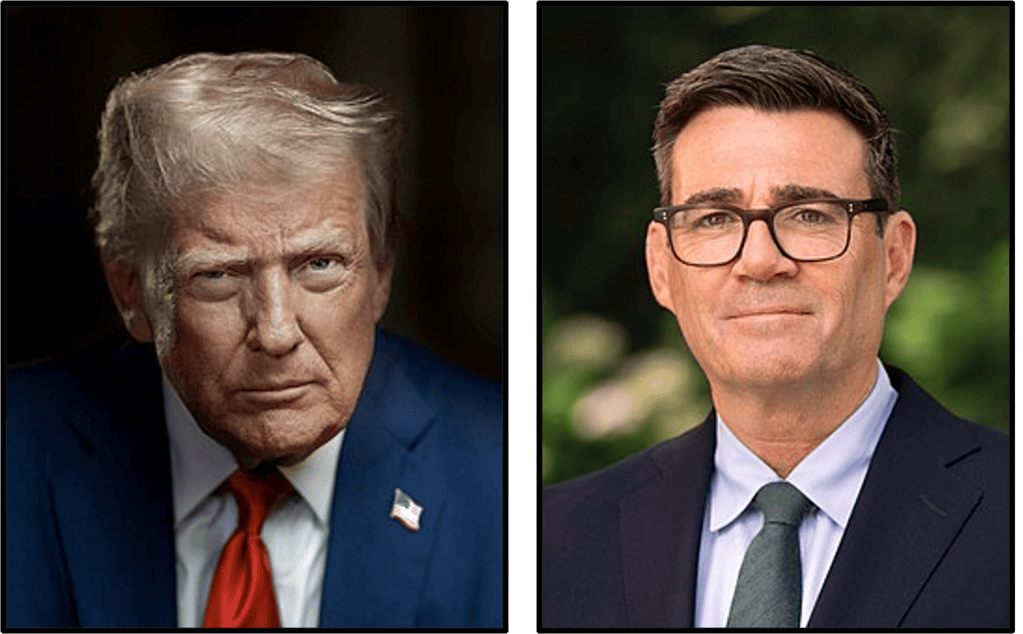
This study examines media coverage of U.S. President Donald Trump and U.K. Prime Minister Andy Burnham during the period from July 28 through August 5. The study was conducted as part of a larger examination of media coverage and was particularly timely given the approach of the 250th anniversary of the United States. Trump and Burnham provide an interesting comparison because they were covered by news organizations operating in different countries and political environments.
The purpose of this study was not to determine whether one leader received more positive or negative coverage than the other. Instead, the goal was to examine what the media was writing about when it covered Trump and Burnham. By tracking the topics of the stories, it was possible to identify patterns in the issues that received the most attention.
The data revealed noticeable differences between the subjects of coverage. Trump stories were concentrated more heavily in foreign affairs, while Burnham stories were more frequently focused on domestic affairs. These differences raise an additional question: Were news organizations emphasizing these issues because they considered them particularly important, or were they primarily reporting on the activities and events involving each political leader?
This distinction is important when considering the role of the media in a democratic society. As Walter Lippmann, wrote in his 1922 book “Public Opinion,” the role of the media is not to simply act as a mirror that provides citizens with a view of what is happening in the world. Instead, he wrote that it is the media’s responsibility to shine a searchlight on activities and events so that informed decisions can be made.
The findings of this study demonstrate differences in media attention, but they cannot by themselves determine whether those differences resulted primarily from editorial choices or from the activities and circumstances surrounding Trump and Burnham.
Research Question
How did U.S. and U.K. media coverage of Donald Trump and Andy Burnham differ in terms of the topics receiving the most attention?
Methodology
The goal of the research was to compare the types of news stories being published about Donald Trump and Andy Burnham and to determine which topics received the most attention during the period studied.
The study used a media-tracking methodology. News stories involving Trump and Burnham were collected over the study period from July 28 through August 5. For each day of the study, five stories about Trump and five stories about Burnham were tracked when available.
For each story, the researcher recorded the date, news outlet, headline, whether the story was about Trump or Burnham, and the primary topic of the story. A second category was also recorded when a story involved another significant topic.
The news outlets represented in the data included major U.S. and U.K. news organizations. U.S. sources included CNN, The New York Times, CBS News, USA Today, NBC News, Associated Press, ABC News, Fox News, The Washington Post, Forbes and other U.S. sources. U.K. sources included BBC News, The Guardian, ITV News, Reuters, Sky News, The Times, The Sun and the Financial Times.
Each article was assigned to a primary content category. The categories used in the study were Defense, Domestic Affairs, Economy, Foreign Affairs, Health Care, Immigration, Justice, Infrastructure, Public Safety, U.S. Politics and Other.
The classification process was based on the primary subject of each headline. For example, stories involving Trump’s meetings with foreign leaders or negotiations concerning Iran were classified as Foreign Affairs. Stories involving tariffs and international trade were classified as Economy, while stories involving domestic government actions or political issues were classified as Domestic Affairs. Burnham stories involving social care were classified as Health Care, while stories concerning government actions and British political issues were classified as Domestic Affairs.
After the tracking period ended, the stories were totaled by category for each political figure. These totals were then compared to identify differences in the topics receiving media attention.
The study focused on the number of stories in each category. The Results section reports those numbers without attempting to explain why the patterns occurred. Analysis and interpretation of the findings are reserved for the Discussion section.
Results
The tracking produced 24 categorized stories about Andy Burnham and 21 categorized stories about Donald Trump during the study period.
Burnham Coverage
The Burnham stories were distributed among eight primary categories. Domestic Affairs accounted for the largest number of stories, with seven. Defense and Justice each accounted for four stories. Health Care accounted for three stories, while Foreign Affairs accounted for two. Economy, Other and Public Safety each accounted for one story.
| Category | Number of Stories |
| Defense | 4 |
| Domestic Affairs | 7 |
| Economy | 1 |
| Foreign Affairs | 2 |
| Health Care | 3 |
| Justice | 4 |
| Other | 2 |
| Public Safety | 1 |
| Total | 24 |
Trump Coverage
Trump’s stories were distributed among nine categories. Foreign Affairs was the largest category, with seven stories. Economy accounted for three stories. Domestic Affairs, Infrastructure, Justice and Public Safety each accounted for two stories. Defense, Immigration and U.S. Politics each accounted for one story.
| Category | Number of Stories |
| Defense | 1 |
| Domestic Affairs | 2 |
| Economy | 3 |
| Foreign Affairs | 7 |
| Immigration | 1 |
| Infrastructure | 2 |
| Justice | 2 |
| Public Safety | 2 |
| U.S. Politics | 1 |
| Total | 21 |
The largest difference between the two sets of stories occurred in Foreign Affairs and Domestic Affairs. Seven of the Trump stories were classified as Foreign Affairs, compared with two Burnham stories. Conversely, seven Burnham stories were classified as Domestic Affairs, compared with two Trump stories.
Other differences also appeared in the data. Burnham had four stories classified as Defense, compared with one for Trump. Burnham also had four Justice stories, compared with two for Trump, and three Health Care stories, a category in which Trump had no stories.
Trump had three Economy stories, compared with one for Burnham. Trump also had stories classified as Immigration, Infrastructure and U.S. Politics, while Burnham did not have stories in those categories during the tracking period.
Overall, the data show that both leaders were covered across a variety of topics, but the distribution of those topics was different. Burnham’s coverage was concentrated most heavily in Domestic Affairs, while Trump’s coverage was concentrated most heavily in Foreign Affairs.
Discussion
The most significant finding in this study is the clear difference between domestic and foreign-affairs coverage of Trump and Burnham. Trump coverage was concentrated most heavily on Foreign Affairs, while Burnham coverage was concentrated most heavily on Domestic Affairs.
Seven of the 21 Trump stories, or approximately one-third of the Trump stories tracked, were classified as Foreign Affairs. By comparison, only two of Burnham’s 24 stories were classified as Foreign Affairs. The opposite pattern appeared with Domestic Affairs. Seven Burnham stories were classified as Domestic Affairs, compared with two Trump stories.
The difference is notable, but it is important to consider what the data actually demonstrate. The study establishes that different topics received different amounts of media attention. It does not establish why those topics received that attention. One possible explanation is that news organizations were responding to the activities and events surrounding each political leader. Another possibility is that journalists and editors made choices about which issues were most important or newsworthy.
This distinction can be understood through the idea of the media as either a “mirror” or a “flashlight.” From a mirror perspective, the media primarily reflects what is happening. If Trump was involved in international negotiations, meetings with foreign leaders, or events involving Iran, Israel and Ukraine, then foreign affairs would naturally become a significant part of his news coverage. Likewise, if Burnham was involved in social care, the prison system, domestic political issues and other matters within the United Kingdom, those activities would naturally produce domestic news stories.
From a flashlight perspective, however, the media does more than simply reflect events. News organizations have limited space and resources and must decide which events to cover and which aspects of those events to emphasize. In this interpretation, the media directs attention toward certain subjects and potentially influences which issues audiences see as important.
The findings of this study do not provide enough evidence to determine which of these explanations is primarily responsible for the differences in coverage. The research measured the stories that were published, but it did not measure every activity or event involving Trump and Burnham during the study period. Therefore, it would be difficult to determine whether the media was responding to a greater number of foreign-affairs events involving Trump or whether news organizations were selectively emphasizing foreign affairs among the events that were available to cover.
The same issue applies to Burnham. The seven stories classified as Domestic Affairs may reflect the fact that Burnham was involved in more domestic political and policy-related activities during the study period. Alternatively, news organizations may have chosen to emphasize those issues because they considered them particularly relevant to their audiences. The data cannot distinguish between these possibilities.
This distinction is important because media coverage is not necessarily evidence of media bias or editorial preference. A large amount of coverage about a particular topic may occur because the political leader generated news about that topic. At the same time, the process of deciding which events become news means that coverage can also influence which issues receive public attention.
This question connects to broader ideas about the role of the media in a democratic society. One view is that the press serves as a mirror, allowing citizens to see what is happening in the world. Another view is that the press acts more like a searchlight, directing attention toward events and issues that journalists and news organizations consider significant. A related perspective argues that the press has a responsibility not simply to report information but to help citizens understand it. The concept of agenda-setting takes this idea further by suggesting that the amount of attention given to an issue can influence the issues that the public perceives as important.
The present study cannot determine whether the media acted primarily as a mirror or a flashlight. It can, however, show that the media attention surrounding the two political figures was directed toward different subjects. That distinction is important because it demonstrates that media coverage involves more than simply measuring how much attention a politician receives. It also involves examining what that attention is directed toward.
The Burnham coverage showed a greater concentration on Justice and Health Care than the Trump coverage. Four Burnham stories were classified as Justice and three were classified as Health Care. Several stories involving Burnham concerned the prison system, prisoner early release and a potential public inquiry. Other stories dealt with social care and end-of-life care.
Trump’s coverage included more stories involving the Economy. Three Trump stories were classified as Economy, including stories about tariffs and trade. His coverage also included two Infrastructure stories and two Justice stories. These categories show that his coverage was not exclusively focused on foreign affairs, although Foreign Affairs clearly stood out as the largest category.
The range of topics also differed between the two leaders. Burnham’s stories were concentrated primarily in Domestic Affairs, Defense, Justice and Health Care. Trump’s stories were spread across a somewhat wider range of categories, including Foreign Affairs, Economy, Domestic Affairs, Infrastructure, Justice, Public Safety, Immigration and U.S. Politics.
The findings should not be interpreted as evidence that American audiences necessarily care more about foreign affairs or that British audiences necessarily care more about domestic affairs. The study measured media coverage, not audience behavior. Similarly, the results do not establish that U.S. or U.K. news organizations deliberately chose these topics to influence public opinion.
The political responsibilities and circumstances surrounding the two leaders may also have contributed to the results. Trump’s position placed him at the center of U.S. decisions involving international conflicts, foreign governments and global trade. Burnham’s political role and the issues surrounding him during the study period were more closely connected to domestic questions within the United Kingdom. These differences could have influenced the amount and type of news generated by each leader.
The most appropriate conclusion is not that the media caused the difference in topic distribution or that the media simply reflected the actions of the two leaders. Instead, the findings demonstrate a difference in media attention and raise questions about the factors that produce that difference. The media may have been responding to the events and activities surrounding each political leader, exercising editorial judgment about which events deserved attention, or doing both.
Conclusion
This study examined media coverage of Donald Trump and Andy Burnham during the period from July 28 through August 5. By tracking news stories and classifying them according to their primary topics, the study found a clear difference in the subjects emphasized in coverage of the two leaders.
The most noticeable finding was the contrast between Foreign Affairs and Domestic Affairs. Foreign Affairs was the largest category for Trump, accounting for seven of his 21 stories. Domestic Affairs was the largest category for Burnham, accounting for seven of his 24 stories.
Trump was frequently associated in the coverage with international affairs, including conflicts, foreign leaders and international negotiations. Burnham was more frequently associated with domestic British issues, including government, social care, justice and other internal policy matters.
The findings, however, should not be understood as proving that the media itself caused these differences. The study raises an important question about whether the media primarily functions as a mirror, reflecting the events and activities of political leaders, or as a flashlight, directing attention toward issues that journalists and news organizations consider significant. The data are consistent with both possibilities.
This distinction represents an important limitation of the study. Because the research measured published news stories rather than the complete range of activities involving Trump and Burnham, it cannot determine whether the differences in coverage resulted from differences in what the two leaders were doing, editorial decisions made by news organizations, or a combination of the two.
The study was also limited to a relatively short period and a specific group of news organizations. A longer study could provide a more complete picture of whether these differences represent a consistent pattern in U.S. and U.K. media coverage or were influenced by the events occurring during the period examined.
Future research could address the mirror-versus-flashlight question more directly by comparing media coverage with the actual activities and events involving each political figure. Researchers could examine which events occurred, which events received coverage, which events were ignored, and how much attention different news organizations gave to the same events. Such research could provide a stronger basis for determining whether differences in coverage primarily reflected differences in political activity or editorial decisions about what deserved attention.
Future research could also examine whether the tone of coverage was positive, negative, or neutral, rather than simply measuring subject matter. Examining the prominence of stories, the placement of stories and the amount of attention given to each issue could provide an additional measure of how news organizations direct public attention.
Even with these limitations, the study demonstrates that media coverage of political leaders can vary substantially in the topics it emphasizes. Trump and Burnham received coverage across a variety of subjects, but the largest concentration of Trump stories involved Foreign Affairs, while the largest concentration of Burnham stories involved Domestic Affairs. More importantly, the findings demonstrate why examining media coverage requires asking not only what the media reports, but also whether that coverage reflects events or directs attention toward particular issues. The present study provides a snapshot of that difference while leaving the larger question of the media’s role as a mirror, a flashlight, or both for further research.
Categories: Jandoli Institute, Media


Leave a Reply