Abstract
September 28, 2026, marks the 50th anniversary of the release of Stevie Wonder’s “Songs in the Key of Life” double album. The recording is regarded as one the best albums of Wonder’s long and illustrious career, as well as one of the greatest albums in the history of popular music. The record is personal. Wonder sings about being a father and pays tribute to artists who preceded him. The album also is universal with songs about faith, love and social justice.
This paper revisits “Songs in the Key of Life” and explores the album’s relevancy 50 years after its release. Does it still connect on a personal level? On a universal level?
Specifically, the paper presents the results of a small study conducted with eight American students who studied at the University of Oxford’s Trinity College during the summer of 2026 as part of St. Bonaventure University’s Francis E. Kelley Oxford program. The students were in Anne Lee’s Women, Minorities & Media course and Richard Lee’s Media & Democracy course.
The students first listened to assigned songs without conducting research and recorded their initial impressions. They then researched the songs, reflected on how contextual knowledge affected their responses, and participated in a workshop identifying recurring themes and patterns.
Students consistently recognized themes of love, spirituality, family, memory, poverty, race, inequality, and social responsibility. They also responded to the album’s upbeat musical character, instrumental variety, vocals, and connections to music they hear today. After research, students generally reported greater appreciation for the lyrics, stories, instrumentation, and effort behind the recordings.
The project suggests that, for this small group of listeners, “Songs in the Key of Life” remained meaningful fifty years after its release and that contextual research deepened engagement with the music. Because the study involved only eight students and relied on qualitative reflection, its findings are best understood as an exploratory account rather than a generalization about an entire generation.
The study was presented at the Mid-Atlantic Popular & American Culture Association’s July 26 Virtual Symposium. This paper contains original materials from the study. Artificial intelligence was used to transform those materials into research paper format.
Keywords: Stevie Wonder; Songs in the Key of Life; popular music; student listening; music appreciation; cultural relevance
Introduction
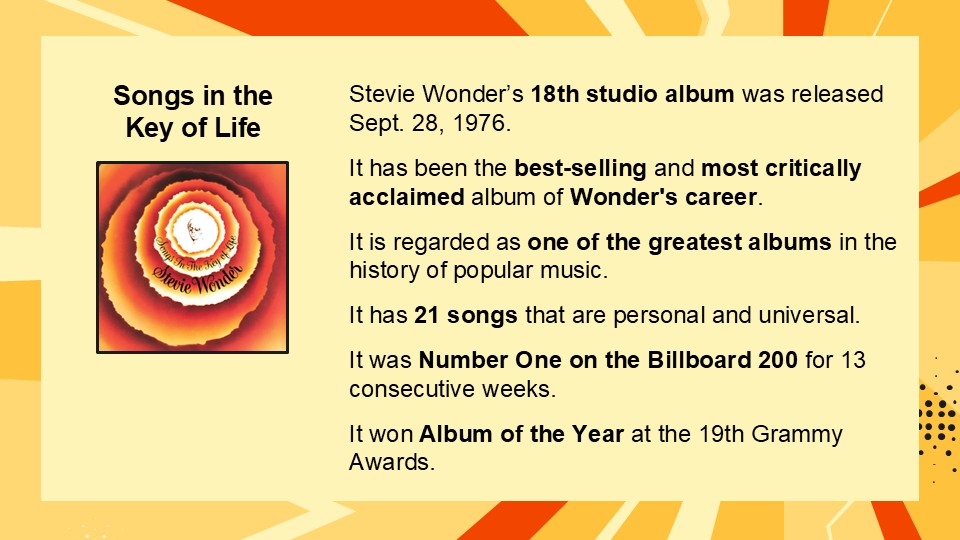
Stevie Wonder’s “Songs in the Key of Life” was released on September 28, 1976, as his eighteenth studio album. The record is the best-selling and most critically acclaimed album of Wonder’s career. It spent thirteen consecutive weeks at number one on the Billboard 200 and won Album of the Year at the 19th Grammy Awards.
More important for the present study, the album’s songs move repeatedly between the personal and the universal. Romantic love, childhood memory, family, spirituality, poverty, race, inequality, and social responsibility appear alongside ambitious arrangements, synthesizers, varied rhythms, and contributions from numerous performers.
Approaching the album near its fiftieth anniversary raises a question that cannot be answered by chart performance or awards alone: does the music still speak to listeners who encounter it in a very different cultural and musical environment? This project therefore focused on contemporary undergraduate responses. Its initial questions were whether “Songs in the Key of Life” is still relevant fifty years after its release and whether it continues to connect on both personal and universal levels. As the project developed, a fourth question emerged: If listeners appreciate songs more after learning their histories, how important is background knowledge to the experience of music?
The study does not attempt to establish a universal verdict on the album’s relevance. Instead, it uses the reactions of eight undergraduate students as a focused qualitative case study. Their responses reveal both what registered immediately during unfiltered listening and what became more meaningful after research. Together, those stages illuminate how lyrical themes, musical construction, biography, and historical context can interact in the reception of a canonical popular-music album.
Methodology
Eight undergraduate college students participated in the project: Matthew Barber, Aubrey Domres, Jacob Frank, Montana Geibel, Elisabeth Hassett, Lyndsey Lilly, Declan McGrath, and Niamh Moore.

Before focusing on individual songs, the students watched two recent documentaries, one concerning Wonder’s life and another concerning the making of “Songs in the Key of Life.”
The listening process was intentionally divided into stages. Students were assigned songs and first listened without conducting outside research. They recorded written first impressions so that their initial reactions would not be shaped by biographical or historical explanations. They later researched their assigned songs and submitted additional written feedback describing what they learned and how that knowledge amplified, complicated, or changed their original impressions.
The group then participated in a workshop session in which students identified themes and patterns across their listening and research. They supplied examples from individual songs and discussed the larger research questions. The approach was qualitative and interpretive: the evidence consists of student observations, written reflections, and group discussion rather than numerical measures of attitude or preference.
Findings: Unfiltered Listening
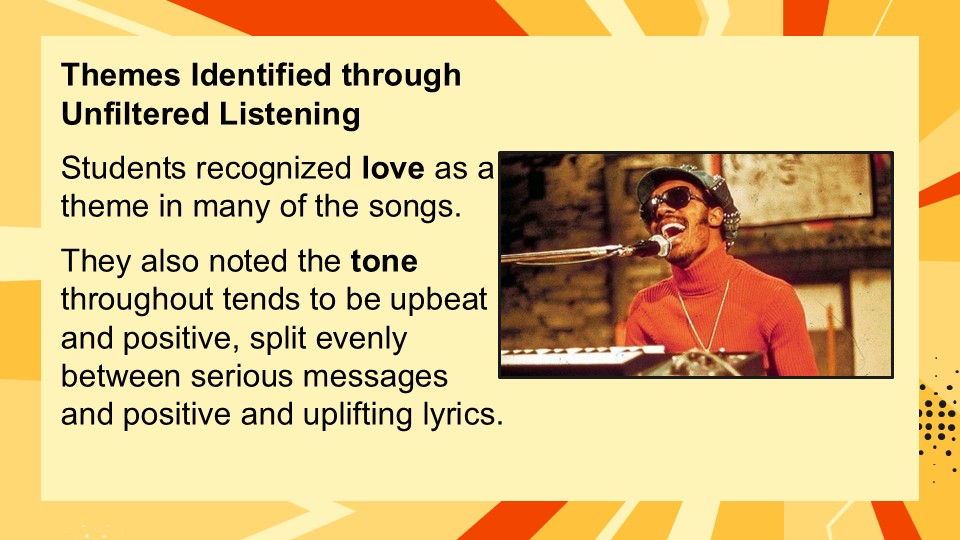
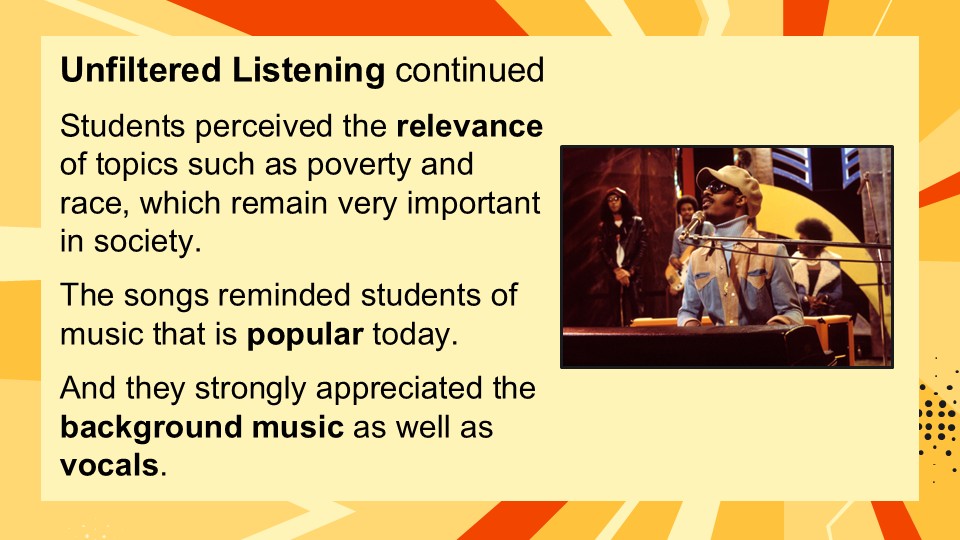
Before research, students already recognized several recurring qualities. Love emerged as a major theme, while the album’s overall tone was often described as upbeat and positive even when individual songs addressed serious subjects. Students perceived a balance between weighty messages and uplifting lyrics. They also identified poverty and race as topics that remain important in contemporary society, suggesting that the album’s social concerns did not feel confined to the 1970s.
Musically, the students responded strongly to both vocals and background instrumentation. Some heard connections between the album and music popular today. These initial reactions are significant because they occurred before the students had investigated the circumstances behind the songs. The first listening stage therefore suggests that much of the album’s accessibility came directly through sound, mood, recognizable emotional situations, and social themes.
Findings: What Research Added
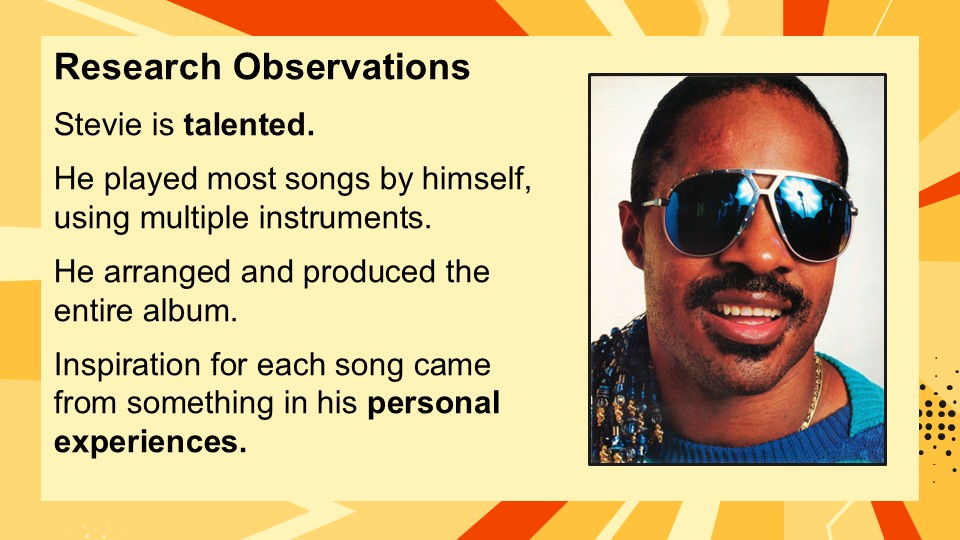
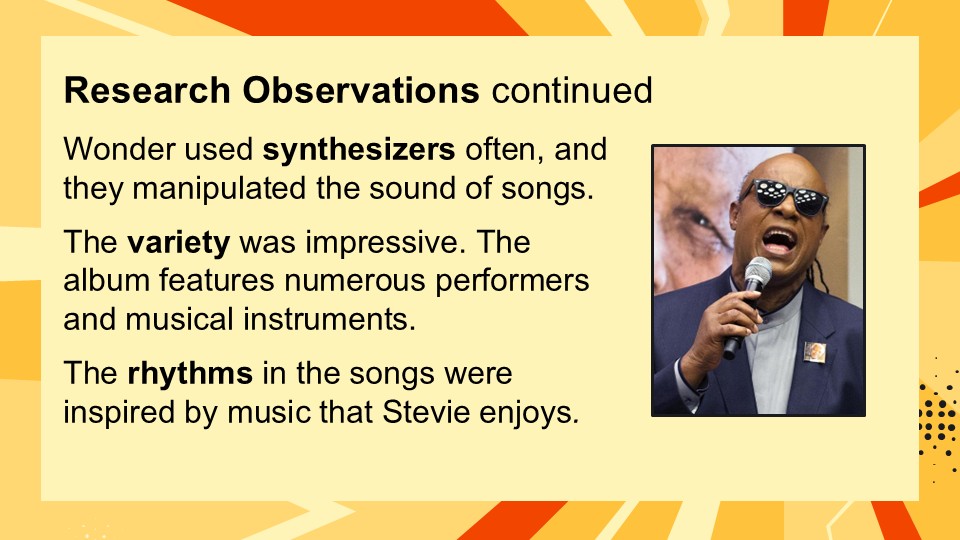
Research shifted attention from immediate response to craft and context. Students emphasized Wonder’s musicianship, noting that he performed many instrumental parts himself and took central roles in arranging and producing the album. They became more attentive to his use of synthesizers, the wide range of instruments and performers, and the ways rhythms reflected music that influenced him. They also repeatedly connected songs to personal experiences in Wonder’s life.
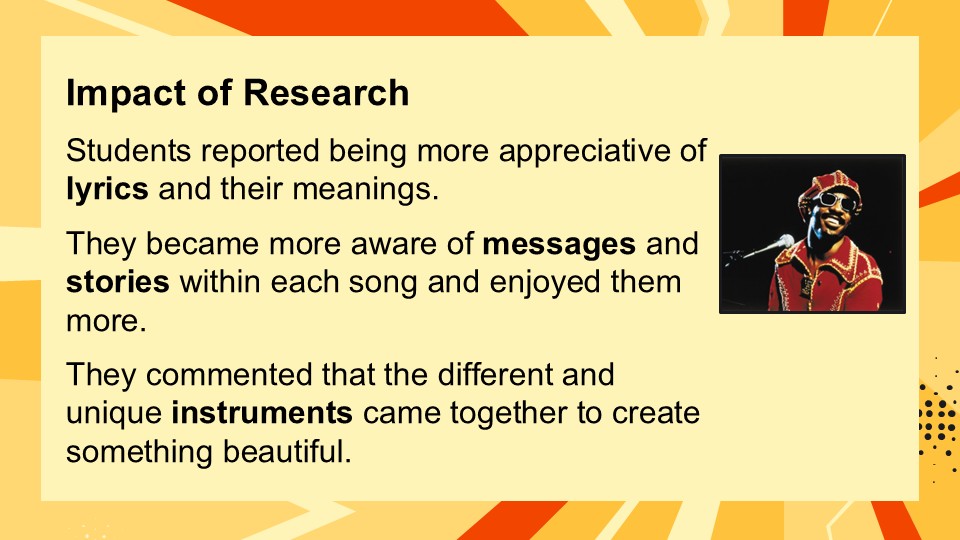
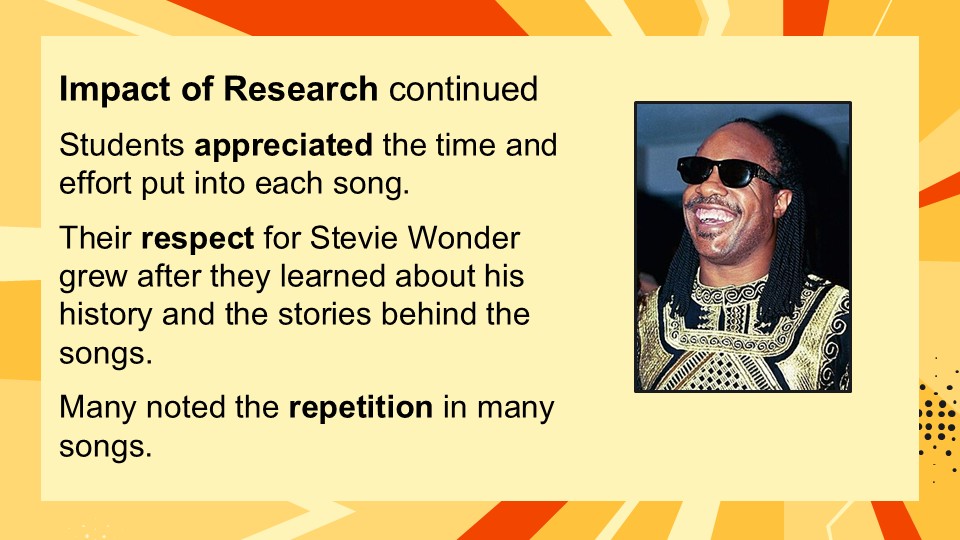
The most consistent change was increased appreciation. Students reported paying closer attention to lyrics and meanings, recognizing stories and messages they had missed, and enjoying songs more after learning about them. They also expressed greater respect for the time and effort involved in constructing the recordings. One recurring musical observation was repetition: several students noticed repeated phrases, choruses, or circular structures and began to interpret repetition as part of a song’s expressive effect rather than merely as a surface feature.
When the group was asked whether it is important to know a song’s background or whether music should simply speak for itself, the consensus favored knowing the background. Niamh Moore summarized the effect of the project by explaining that the research changed how she listened, encouraging closer attention to lyrics and themes while highlighting Wonder’s ability to transform personal memories and emotions into songs.
The result does not imply that contextual knowledge is required for musical enjoyment; the students had already responded positively during unfiltered listening. Rather, their reflections indicate that context added a second layer of engagement.
Findings: Impact of the Research
Love, Vulnerability, and Personal Memory
Several songs demonstrate how the album translates intimate experiences into themes students understood as broadly recognizable. In “I Wish,” Niamh Moore focused on Wonder’s desire to return to childhood and on the story that a Motown picnic prompted him to go to the studio and write the song. Learning that the piece developed from a more nostalgic conception into a joyful track strengthened her appreciation for Wonder’s ability to make a personal memory feel both intimate and universal.
Declan McGrath interpreted “Knocks Me Off My Feet” as a portrayal of romantic love powerful enough to create vulnerability and hesitation. His research drew attention to Wonder’s performance of the instrumental parts and to rhythmic hesitations that could be heard as reflecting emotional hesitation. Aubrey Domres similarly emphasized musical storytelling in “Ordinary Pain,” where a failed romance shifts from a sad ballad to a funkier section and from a male to a female point of view. For Domres, the change in background music helped distinguish the emotional states of the two characters.
Other responses extended the album’s treatment of love beyond romance. “Isn’t She Lovely” carried a direct personal association for Anne and Richard Lee, who connected it with the birth of their daughter and later with seeing Wonder introduce his own daughter onstage. “Easy Goin’ Evening (My Mama’s Call),” as Matthew Barber observed, centers on family, home, and the comfort of returning to loved ones. These examples show how the album’s personal material can invite listeners to connect Wonder’s experiences with their own memories and relationships.
Spirituality, Compassion, and Responsibility
Matthew Barber’s work on “Love’s in Need of Love Today” and “Have a Talk with God” identified a spiritual current running through the album. The opening track combines a reflective tone with a warning about society, presenting love as something that must be actively protected. Barber also interpreted its spirituality in terms of faith, compassion, and responsibility toward others. His research noted the song’s later performance after the September 11, 2001, attacks, an example of how a song written decades earlier could be placed in a new historical setting.
“Have a Talk with God,” co-written with Calvin Hardaway, presents faith as a response to difficulty and isolation. Barber noted that its synthesizer-driven sound distinguishes it from a conventional gospel performance while its message can be heard more broadly as one of hope, guidance, and peace. In the students’ responses, spirituality therefore functioned not as an isolated topic but as part of the album’s larger concern with how people respond to one another and to hardship.
Social Inequality and Collective Life
The album’s social commentary was among the clearest reasons students gave for its continuing relevance. Barber described “Village Ghetto Land,” co-written with Gary Byrd, as confronting poverty, hunger, crime, homelessness, and lack of opportunity. The track’s dramatic synthesizer-created orchestral sound contrasts with its disturbing subject matter. That contrast helped students see how musical choices can intensify social commentary rather than merely accompany it.
Montana Geibel’s response to “Black Man” emphasized its effort to recognize overlooked achievements by people of different races and its call for greater harmony. Geibel understood the song as moving beyond Wonder’s personal life to address the nation and the unequal distribution of historical credit. “Saturn,” researched by Declan McGrath, widened the frame further. Its imagined extraterrestrial perspective becomes a means of criticizing war, pollution, greed, and hypocrisy while contrasting Earth with a utopian alternative. Across these songs, the students encountered social concerns that they regarded as recognizable in the present.
Music as Connection Across Time and Culture
“Sir Duke” makes music itself a subject. Anne and Richard Lee emphasized the song’s tributes to Duke Ellington, Count Basie, Glenn Miller, Louis Armstrong, and Ella Fitzgerald and its presentation of music as a shared language. Montana Geibel found a similar idea in “Ngiculela—Es Una Historia—I Am Singing,” whose vocals move among Zulu, Spanish, and English. For Geibel, the multilingual form reinforces a message of love, peace, and music’s capacity to connect people even when every listener does not understand every word.
Lyndsey Lilly’s work on “Another Star” highlighted another form of musical crossing: Wonder’s interest in Latin American and Brazilian music, heard in the song’s rhythms and percussion. The students’ broader observations about the album likewise stressed stylistic variety and the presence of numerous musicians and instruments. The album’s continuing appeal, in their accounts, depended not only on what the songs said but on the range of musical languages through which they said it.
Reflection, Time, and Change
Several songs invited students to think about time. Lyndsey Lilly interpreted “Pastime Paradise” as a call to examine the present and build a better future rather than becoming trapped in an idealized past. Elisabeth Hassett read “Summer Soft” through seasonal imagery and changing musical keys, connecting cycles in nature with cycles in a relationship. Her response to “As” focused on repetition and circularity: the song’s length and recurring structure can make its declaration of love feel as though it might continue indefinitely.
Jacob Frank’s response to “If It’s Magic” likewise centered on the tension between beauty and impermanence, while “Joy Inside My Tears” joined hope with struggle and drew attention to the many musicians and singers involved in the album. Niamh Moore’s research on “All Day Sucker” provides a particularly direct example of the study’s central pattern: she initially enjoyed the melody and background music, then found that research into the song’s emotions, experiences, and historical context gave her a fuller understanding of its creation.
Collaboration and Musicianship
Although Wonder’s individual musicianship impressed the students, the project also highlighted collaboration. Greg Phillinganes contributed keyboards and later became known for work with Michael Jackson. Dorothy Ashby’s harp is central to “If It’s Magic,” where she is the only other performer identified in the project materials alongside Wonder. Renee Hardaway, Wonder’s sister, supplies the voice representing young Stevie in “I Wish,” strengthening the song’s connection to childhood memory. The project also notes the West Los Angeles Church of God Choir near the end of “Pastime Paradise.” These contributions complicated any simple image of the album as a purely solitary achievement: Wonder’s authorship and production coexist with carefully chosen collaborators whose sounds and identities shape particular tracks.
Discussion
Taken together, the students’ responses support a qualified answer to the project’s central questions. Within this group, “Songs in the Key of Life” remained relevant because its subjects were immediately legible: love, vulnerability, faith, childhood, family, inequality, race, poverty, memory, and hopes for a better society. The students did not need extensive historical preparation to recognize those concerns. They also found the album musically engaging through its vocals, instrumental textures, upbeat passages, rhythmic variety, and stylistic range.
At the same time, research altered the quality of that engagement. Biographical stories made personal songs more concrete; production details made instrumental choices more noticeable; and historical information gave social themes additional context. The project therefore suggests a productive relationship between direct listening and contextual study. Unfiltered listening allowed students to encounter the music on their own terms, while research encouraged them to revisit first impressions with greater attention to craft, history, and intention.
The findings also point toward a broader question in popular-music education. Canonical works can sometimes be presented to younger listeners primarily through reputation: they are important because critics, charts, awards, or earlier generations say they are important. This project used a different route. It first asked students what they actually heard and only later supplied a research stage. That sequence gave their initial reactions independent value while still allowing scholarship and context to deepen interpretation.
Limitations
The study has important limitations. It involved only eight undergraduate students, and the participants were not selected to represent a larger population. Their assignments also covered different songs, so not every participant responded to every track. The project relied on written impressions and group discussion rather than a standardized survey or quantitative measure of change. In addition, the source list assembled for the presentation varies in type, ranging from criticism and music-reference sites to documentaries and analytical materials. The findings should therefore be read as exploratory qualitative observations about this particular learning experience.
Conclusion
Fifty years after the release of “Songs in the Key of Life,”the students in this project found that the album still connected with them both personally and through larger social concerns. Their first impressions identified themes and musical qualities that felt accessible without explanation. Their later research increased attention to lyrics, stories, instrumentation, collaboration, and the experiences behind individual songs. The strongest conclusion is therefore not simply that an acclaimed album has endured, but that active listening followed by contextual research can reveal why it continues to matter to particular listeners.
Jacob Frank’s closing reflection captures the project’s central insight: the story behind each track made the human effort surrounding the album more tangible and helped explain why the music still held up for him. Across the group, that pattern recurred in different forms. The songs spoke first through sound and subject; research then made their construction and histories more visible. For these students, the key to the album’s continuing life was the interaction of both experiences.
Works Cited
“Black Man,” A Genius Stevie Wonder.
Light, Alan. “Songs in the Key of Life,” Pitchfork, August 21, 2016.
“Stevie Wonder’s ‘As’ – Chord voicings and analysis,” The Piano Shed, Oct. 4, 2013.
“Stevie Wonder: I Wish,” Classic Motown.
Stevie Wonder – Songs In The Key of Life: Documentary
“Stevie Wonder|Summer Soft,” Modulation of the Day.
Stevie Wonder: The Incredible Story of a Musical Visionary

