By Scott Medler with Tammy Rae Matthews
Fall days in Western New York are beautiful. Cool nights change into bright, warm days. By early October, the foliage on the forested hills is bright, with a variety of orange, yellow, and red. For many in this region, fall is the season for apple picking, enjoying fresh apple cider, or getting lost in a corn maze.

In my world, fall is the time to check which oak trees are loaded with acorns and watch for the precise day they start dropping. Collecting 25 pounds or more in less than an hour is typical. Innovative chefs can use acorn flour as a gluten-free alternative in many recipes. My favorite is acorn pancakes made with berries and served with local maple syrup.
Acorns have been a staple of human nutrition worldwide for millennia and are still familiar in some cultures. However, in modern industrialized society, many see acorns as fodder for animals or as an annoyance to clean manicured lawns and sidewalks.
Acorns are a highly nutritious food with many potential health benefits. Acorn flour is rich in fats, carbohydrates, and proteins. Pound for pound, acorn flour is more nutritious than the familiar staples of corn, wheat, or rice. Acorns are higher in potassium than bananas and provide generous dietary fiber servings.
Recent studies suggest that eating acorn-containing foods may help lower blood glucose levels. Food scientists believe the polyphenols in acorns provide essential antioxidant activity.
Why aren’t more people out collecting acorns each fall and enjoying the delicious benefits of acorn flour? Americans generally don’t recognize acorns as food within our popular culture. However, several forward-thinking people have extolled the virtues of acorns as an alternative food source.
Acorns as Food in the 20th Century
In 1918, C. Hart Merriam wrote a piece for the National Geographic magazine, laying out the case for acorns as a neglected food source. Merriam was an American zoologist and contemporary of Theodore Roosevelt, who served as the Chief of the U.S. Biological Survey.

Later in his career, Merriam became so fascinated by the Indigenous peoples of California that he devoted the rest of his life to studying the languages, cultures, and practices of Western American tribes. He aimed to document their traditions before these cultural histories were lost forever.
“In view of the present pressure on the food supply of the United States, and with special reference to the universal effort to reduce the use of wheat by the substitution of corn meal, bran, and other products, it may be worthwhile to call attention to the high nutritive value of a wholly neglected food of wide distribution. I refer to the acorn,” Merriam said.
Over the years, other acorn enthusiasts agreed with Merriam’s position that our society has overlooked the nutritional value of these abundant tree nuts.
In the 1980s, David A. Bainbridge wrote many papers outlining the benefits of acorn consumption. Many of these papers, including “Use of Acorns for Food in California: Past, Present, and Future,” can easily be accessed online today. Trained as a restoration ecologist, Bainbridge presented a compelling case for acorns as an economic crop. The above publication also has a good reference section for those interested in learning more about the benefits of using acorns as food.
An Acorn Renaissance?
More recently, Marcie Mayer, an American expat who has made her home on the island of Kea in Greece since 1997, has become an international expert and a leading authority on acorns as a food resource (https://www.marciemayer.com/oakmeal). Kea is home to established populations of Mediterranean oak trees, Quercus ithaburensis, which produce exceptionally large acorns with an enormous cap.
Mayer became fascinated with the potential of acorns as a food resource and began experimenting with acorn meal for cooking. She learned more about the food potential of acorns from Bainbridge, who mentored her and encouraged her interests.
Mayer says she had an aha moment in 2009 when she realized she wanted her life to revolve around her work with acorns. She is a passionate and inspiring advocate for acorns as food and for more holistic, sustainable living. Her initiative has focused on promoting sustainable oak-based income for farm families on Kea.
While Mayer collected acorns for food, the local farmers collected the acorn caps for exportation to traditional leather tanneries. In 2019, she published a book, “Eating Acorns. A Field Guide-Cookbook-Inspiration.” The book highlights her operation and provides a large number of acorn recipes.
Mayer put me into contact with another acorn enthusiast, Daniela Dana, who lives closer to me in the northeastern U.S. When we spoke last fall, she drove with her mom to go acorn collecting. Dana began collecting acorns and making meal in 2011 after reading “Oak: The Frame of Civilization” by William Bryant Logan.
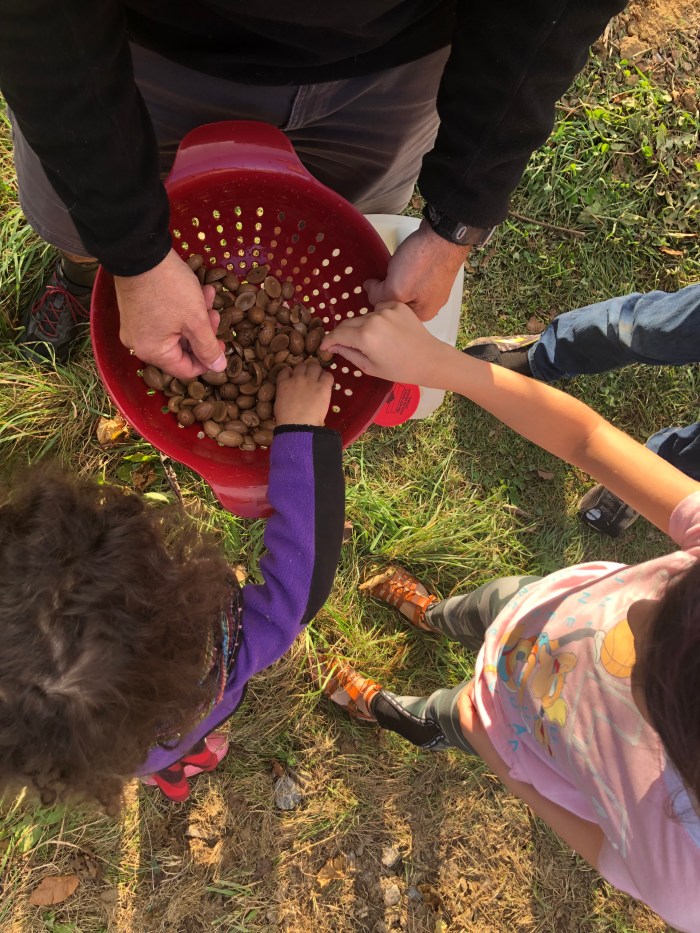
Daniela subsequently visited Marcie Mayer to learn about acorn collection and processing on three trips to Kea. Marcie encouraged Dana to found the New England Acorn Cooperative in the Boston area (https://newenglandacorncooperative.com/). Her idea was to bring together like-minded people to share ideas and resources related to the production and uses of acorn meal. Dana has hosted an Acorn Festival each November for the past seven years at the Hummingbird Center in rural New Hampshire. My wife and I enjoyed attending the Acorn Festival in October 2023. During the inspiring experience, we met other individuals and families interested in acorns as food.
Acorn Entrepreneurs
Several business-minded individuals have recently experimented with acorn products in the U.S. Jay Avis is an engineer who founded a small acorn flour business named Oaklore in Vermont. He moved from the Boston area to Norwich, VT, with his wife in 2012 and produced flour made from native red oak acorns (https://www.jayavis.com).
Avis says his endeavor in acorn processing began with his interest in primitive survival skills. Those interests merged with his training as a mechanical engineer, and Avis began experimenting with new ways to scale up the production of acorn flour. After several years of fine-tuning his production methods, Avis used a multi-step process to produce 750 lbs. of flour in one year! He initially thought that acorn flour might be a big seller at local farmer’s markets, but soon realized that the $25 per pound of the finished flour was more than most locals were willing to pay. However, he did find a market with upstart restaurants led by young, tattooed chefs interested in experimenting with alternative foods.
In 2014, Mimi Brown and her sister-in-law founded Mighty Wild, a Texas company that produced gluten-free products from acorns (https://www.mightywild.com/). Mimi is a commodities trader with experience in supply chain management and finance. Her sister-in-law has experience with marketing and product development.
The pair brought a more business-minded perspective to acorn-based foods than other acorn enthusiasts. They developed a network of acorn foragers in the mid-west. These collectors packaged the acorns into large mesh bags and shipped them to a pecan farm in Texas for processing.
Ultimately, Mighty Wild “produced an acorn cracker that was delicious and gluten-free,”Brown said.
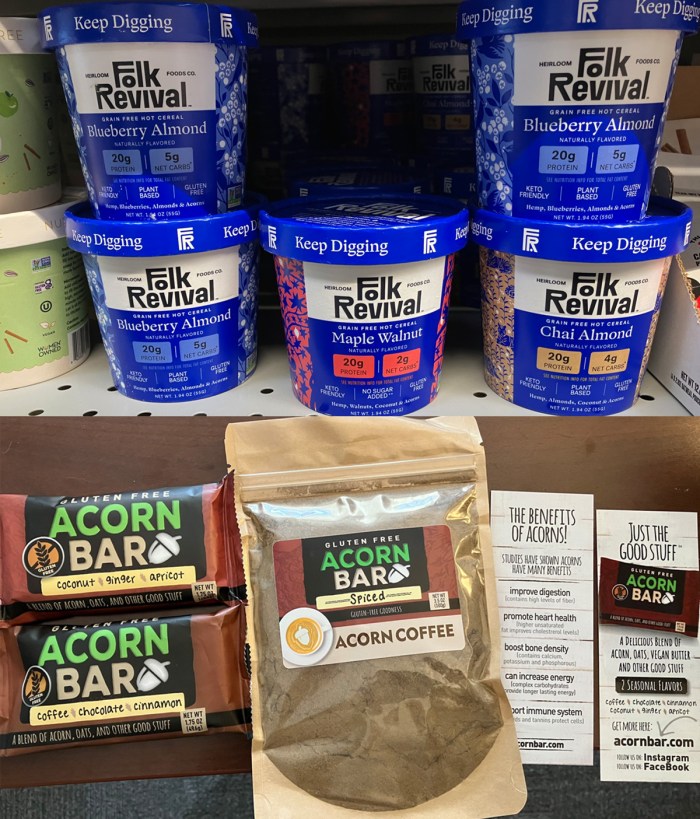
Narda Fargotstein lives in Thousand Oaks, California, and the city’s name is appropriate. Fargotstein said that some of the trees are 500 years old. The trees drop so many acorns in mast years that they fill the city streets. These trees are Valley Oaks, and Fargotstein uses the acorns in her gluten-free acorn bars, produced by the Thousand Oaks Acorn Company (https://acornbar.com/).
In addition to the acorn bars, Fargotstein sells acorn coffee and acorn flour. When I spoke to Fargotstein, she was preparing to attend the Natural Products Expo West in Anaheim. The organizers of this annual event gear it towards natural and organic food industry professionals.
David Cantor is the founder and CEO of Folk Revival, a food company committed to incorporating heirloom foods into their products. The company’s first product is a high-protein, low-carb breakfast cereal set to compete against ready-to-eat oatmeal. The cereal is rich in nuts, hemp, and acorn flour.
Cantor has a long interest in sustainable food systems. After college, he founded a small organic vegetable farm in New Mexico. Later, he earned a master’s degree in nutrition from Tufts University. After 20 years in the food industry, he capitalized on an opportunity to launch his food startup based on natural foods. Folk Revival Hot Cereal Cups are available on the shelves of Whole Foods Markets all along the East Coast. So far, the grain-free and gluten-free cereals are selling well, and Cantor is looking for investors to expand its market.
Opportunities and Challenges
Although few in the U.S. consume acorns in any form, other countries have an acorn market. South Koreans consume more than 30 million pounds per year. The primary market for acorn products in North America is within Asian communities that still consume these traditional, acorn-based foods. As Americans become more interested in locally produced sustainable foods, perhaps acorn flour will become more popular.
“Acorns produce perhaps the world’s most sustainable flour,” Cantor said. “Oak trees don’t require any irrigation, fertilizer or pesticides, and they are part of diverse forest ecosystems, which, of course, help capture carbon.”
What’s keeping acorn flour off U.S. grocery store shelves?
Currently, no established U.S. supply chains produce and reliably deliver acorn flour to food makers. On Kea, Marcie Mayer relies on volunteers to produce roughly 10,000 pounds of flour yearly.
“What I’ve done on Kea is definitely scalable,” Mayer said.
U.S. acorn entrepreneurs have attempted to scale up production to meet market demands but have experienced difficulties. Mimi Brown said that scaling up production and several systems failures finally did them in. After returning on the investments generated by a Kickstarter Campaign, she and her partner decided to end their project at Mighty Wild.
In Vermont, Avis grew weary after running Oaklore alone for several years and finally called it quits. Cantor and Fargotstein are still in the acorn business and working hard to find a foothold for their products. Time will tell how enthusiastic the public may become about including acorns in daily diets.
Acorns Meet Agroforestry
I recently visited with Gregory Ormsby Mori, who operates an agribusiness in Western Massachusetts called Forestopia (http://www.forestopia.org/). Osmsby Mori brings a deep experience in agroforestry to the challenges of the acorn business. From 2014 – 2020, he worked to develop new crops at The Center for Agroforestry at the University of Missouri (https://centerforagroforestry.org/).
What is agroforestry? Agroforestry is fundamentally the integration of perennial trees and shrubs into sustainable agriculture. If you know anyone who taps maple trees to harvest syrup, that is an example of agroforestry. Forestopia offers a variety of sustainably produced tree products from around the world. These currently include coffee, tea, cocoa, tree nuts, and flours made from tree nuts. Ormsby Mori also has several projects involving acorns.
In a 2017 book, “Integrating Landscapes: Agroforestry for Biodiversity Conservation and Food Sovereignty,” Ormsby Mori and two coauthors contributed a chapter on agroforestry in the Midwest U.S.
The authors offered this perspective: “Transforming agricultural practices to include a wider array of perennial species presents numerous advantages, both environmental and economic, over many current land use practices.”
“I think it is time for acorns,” Osmsby Mori said. Many opportunities exist, yet navigating through various barriers and bottlenecks in production remains essential, prompting Osmsby Mori to consider diversifying products for different markets.
For example, he knows a farm couple in Massachusetts who collect 30-60,000 pounds of red oak acorns every year to feed their hogs. This practice resembles a centuries-long tradition in Spain and Portugal, where they feed their pigs acorns to fatten them before slaughter. The resulting jamón ibérico is a ham world-famous for its unique texture and delicious flavor.
Another strategy could be to connect production with another nut, such as chestnuts. Scientists have genetically engineered North American chestnut trees have to resist the blight that caused a population crash in the 20th Century. Osmsby Mori said the chestnut industry will expand over the next 5-10 years.
Making Your Own Acorn Flour
The good news is that you can make acorn flour for yourself!
In my own life, I began collecting acorns and cooking with acorns more than 30 years ago while I was a graduate student in San Diego. The eastern part of San Diego County includes rugged mountains that reach a height of more than 6,000 feet before descending into the Anza Borrego desert. I spent much of my free time exploring these mountains and valleys, home to coastal live oak trees. I discovered ancient mortars ground into some of the large granite boulders lining the creek beds. The Indigenous people of California used these for millennia to pound acorns into flour.
I remember the first time I collected acorns from the mountain valleys. After the acorns had fallen from the trees, there were so many that I could scoop up acorns with both hands. I collected several pounds in my dad’s old army duffle bag and hauled them up the steep trail to take home.
Like California, Western New York has an abundance of native oaks. After years of experimenting, I have adopted my methods for hand-crafting small batches of acorn flour.
First, freshly collected acorns should be well-dried.
After shelling the acorns, leach whole nut meats in cold water to remove tannins (about one week).
These rehydrated acorn meats are then ground into meal and dried again.
Coarse acorn meal can be stored for long periods in the freezer and finely ground with a coffee mill just before use.
For people interested in making acorn flour, watch this short video demonstrating the steps.
Scott Medler is an associate professor of physician assistant studies at St. Bonaventure University. Tammy Rae Matthews is an assistant professor in the Jandoli School of Communication at St. Bonaventure.
* * *
Visit our Hybrid Journalism Page to learn more about the project and view other articles. To learn more about this article, view a conversation with the authors, hosted by Cassidey Kavathas.
Categories: hybrid journalism, Jandoli Institute
 Jandoli Institute
Leave a comment