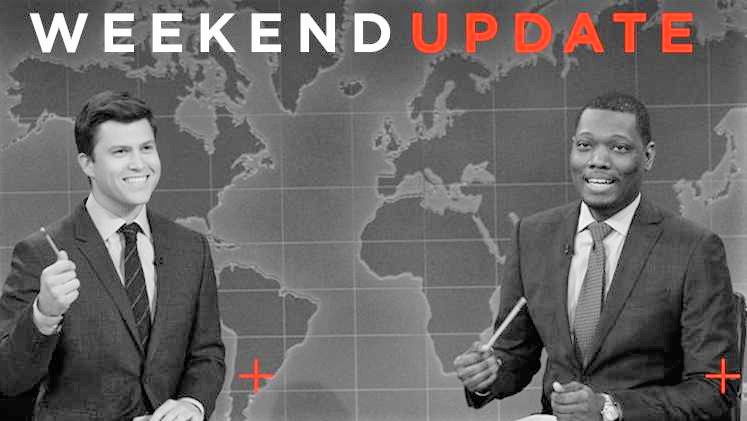
You’ll get more than laughs if you watch “Saturday Night Live” Weekend Update regularly.
A study conducted by students at St. Bonaventure University showed that 70% of the content in SNL Weekend Update is news that is accurate and factual.
The study was conducted in a Media and Pop Culture course taught by Dr. Richard Lee, a professor in St. Bonaventure’s Jandoli School of Communication.
During the spring semester, each student in the class selected an episode from the 2023-24 season of “Saturday Night Live” and fact-checked the episode’s Weekend Update segment.
Students were required to find news stories, videos, transcripts and other items to prove that statements made in Weekend Update were true. If they were unable to document a statement, they labeled it “could be true” or “clearly not true.”
In the 18 episodes they fact-checked, 269 of the 384 statements made in SNL Weekend Update segments were true. They labeled 93 statements “clearly not true” and 25 “could be true.”
“By no means is SNL Weekend Update a substitute for professional journalism entities,” Lee said, “but its content does provide viewers with factual information about people, places and activities, albeit with touches of humor and without the depth provided by regular news sources.”
Examples of what is accurate and factual content from SNL Weekend Update included:
- Rep. Mike Johnson was elected Speaker of the U.S. House of Representatives.
- The Arizona Supreme Court reinstated an 1864 law banning doctors from performing abortions.
- The U.S. Supreme Court has established a new code of ethics.
- George Santos was indicted on federal charges.
- Rosalynn Carter, Henry Kissinger and Sandra Day O’Connor died.
- The Florida Supreme Court has allowed a six-week abortion ban to take effect.
- Rosalynn Carter, Henry Kissinger and Sandra Day O’Conner died.
- Sen. Mitch McConnell will step down as Republican Leader in the U.S. Senate.
“The general consensus among the students was that watching SNL Weekend Update will keep one somewhat informed on the news, but it is not a valid alternative to following standard news sites,” Lee said.
Some of the common observations from the class were:
- The information presented in the Weekend Updates was very limited and provided no in-depth reporting or insight, leaving viewers with only a sliver of the news.
- Telling truth from fiction in the segments can be difficult, especially for those who do not follow current events regularly.
- The comedic nature of Weekend Update detracts from seriousness of the topics.
Several students noted that they saw no references to war, natural disasters and other disturbing news events, but the absence of these items appeared to vary by episode. Some members of the class did report seeing such topics in the episodes they watched.
Lee said the Weekend Update project underscored one of the underlying theories of his Media and Pop Culture course.
“Pop culture is more than entertainment,” he explained. “Its role in public policy and the media landscape is growing.”
The inspiration for the project was a 2006 study on “The Daily Show” by Geoffrey Baym, who is now a professor in the Department of Media Studies and Production at Temple University.
In the study, “The Daily Show: Discursive Integration and the Reinvention of Political Journalism,” Baym found that “the content of ‘The Daily Show’ resembled much of the mainstream news media.” He added, “Always silly and at times ridiculous, these stories do offer a measure of insight into topics of significance for the political process.”
Other research conducted around the time of Baym’s study showed that people between the ages of 18 and 29 were turning away from mainstream news outlets and obtaining news from entertainment television.
“Those individuals are now in their 30s and 40s and will be casting votes in what may be the most important presidential election in U.S. history,” Lee said. “Entertainment could very well play a role – directly or indirectly – in how we choose the nation’s chief executive.”
Categories: Jandoli Institute, Media, Pop Culture, Research, Richard Lee, richleeonline
 Jandoli Institute
Leave a comment