By David Kassnoff
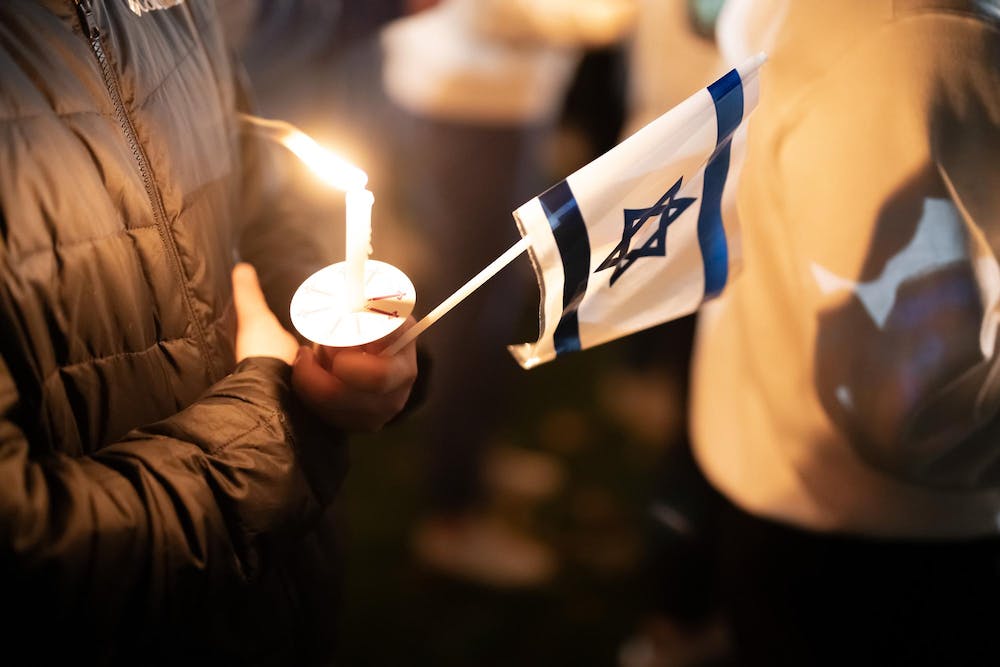
October’s Hamas attacks on Israel hit close to home. I learned last week that a friend’s daughter living in Israel fled to a bomb shelter to escape a rocket barrage. Each weeknight, in my upstate New York community, our synagogue’s rabbi holds a “circle of support” online gathering for temple members to share prayers and concerns, and show our support for our friend, her daughter, and all daughters and sons facing threats of torture and execution there.
This is antisemitism. In Israel, it’s Hamas’ quest to slaughter Jews. In New York City last week, I observed pro-Palestinian protesters demonstrating in Times Square. Some flashed swastikas, others became verbally inflammatory. Dozens of NYPD officers watched nearby. A few days later, I viewed an online video purportedly from London in which two women wearing hijabs removed posters of those missing in Israel from walls along a street. All are acts of antisemitism.
I contrasted this with the Yom Kippur (Arab Israeli) War of 1973, and my family’s response in the New York suburbs. We went together to silently march, with picket signs, at the then-new shopping mall nearby. Our somewhat subdued pro-Israel demonstration drew no police. Given the era’s technology, there was no TikTok video of this demonstration.
I’m no stranger to antisemitism in our world or in academia. One Sunday morning in August, 1975, my brand-new college roommate — upon discovering my Jewish heritage — demanded a different roommate. A St. Bonaventure University residence director swiftly arranged the switch.
Times change. The university soon instituted a new theology course, “Contemporary Jewish Thought,” taught by a local rabbi. Today, the university hosts a Center for Arab & Islamic Studies, led by a Franciscan friar.
Today, political and philosophical debate careens across social media and college campuses. It’s sadly familiar. I feel the existential threat that Jews worldwide have experienced since long before the Holocaust. The ferocious Hamas onslaught slaughtered civilians, not combatants. We are aghast and disgusted, but we needn’t look across oceans or decades to see examples of antisemitism in our own country.
Are there multiple interpretations of Israel’s harsh treatment of Gaza residents? Yes, because few of us live in today’s Israel or Gaza or Lebanon or Syria. And social media distorts the stories we read and watch. The New Yorker this week called the situation “an impossible dilemma,” forecasting more tragedies. But, I come back to the real threat Jews face, here and overseas. The Anti-Defamation League (ADL) reports that 106 antisemitic incidents have taken place in New York state in 2023, and another 72 incidents where white supremacist propaganda was distributed.
What have we learned? Not enough. There are no answers where hatred exists. In the face of an Israeli military response, Hamas appears willing to sacrifice civilians in Gaza in its quest to eradicate Jews. And Hamas’ leaders must have known, going in, that killing Jews in Israel opened a door to global condemnation and Israel’s retribution.
David Kassnoff has worked in journalism, public relations and higher education. For several years, he was a lecturer in the Jandoli School of Communication at St. Bonaventure University.
Categories: Jandoli Institute
 Jandoli Institute
Leave a comment